With Election Day approaching, shifting political winds, falling pressure, and tightening races have South Carolina bracing for a storm few saw coming.
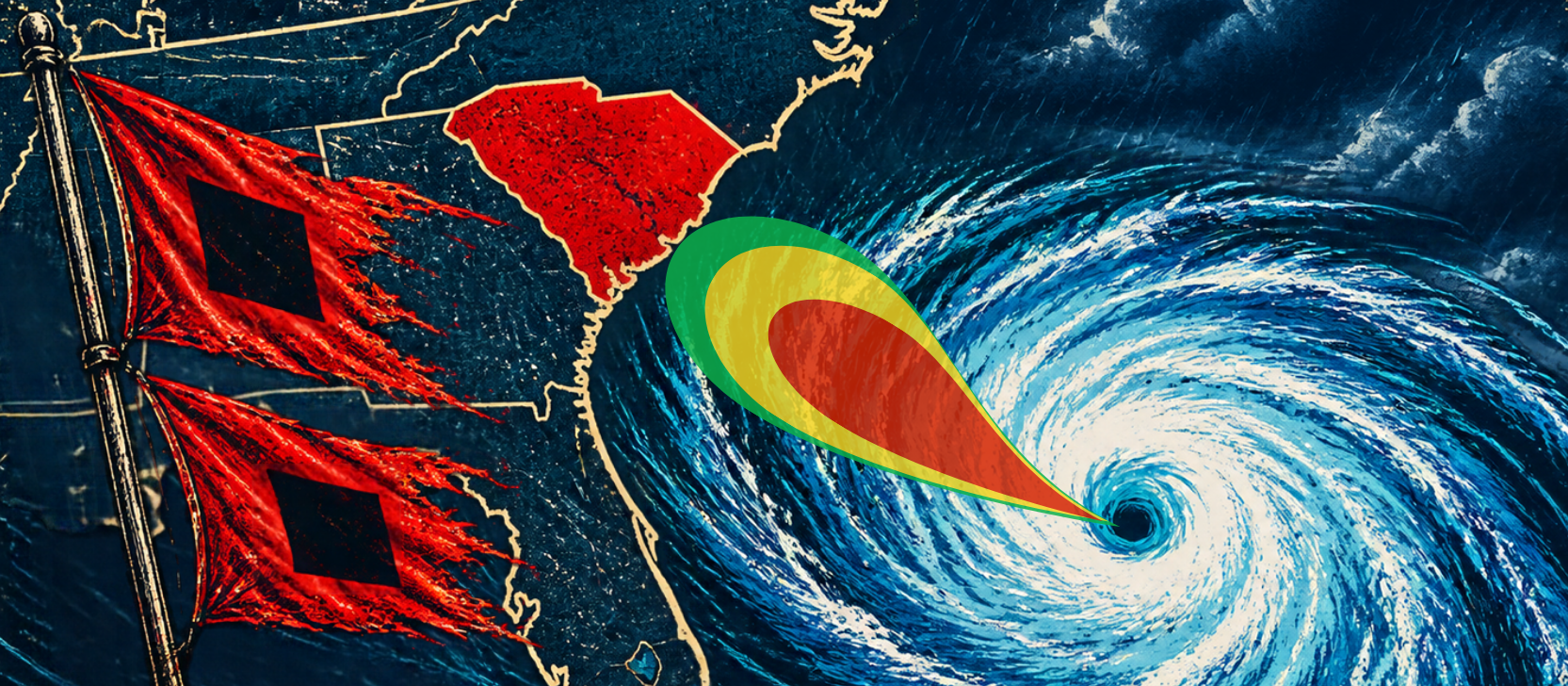
South Carolinians know a thing or two about hurricanes. We know how quickly atmospheric conditions can change. We’ve seen how an approaching storm can shift course. And we’ve lived through storms once thought to be little more than a tropical disturbance rapidly intensifying into something far more destructive.
But the political storm brewing over the Palmetto State may be one that Republicans aren’t fully prepared for if it makes landfall on November 3.
With President Donald Trump’s approval rating hovering in the mid-30s, the political barometer across the state and nation has been falling, and the prevailing winds appear to be shifting.
What once looked like a relatively calm election season for Republicans has quickly developed into an increasingly unstable political atmosphere, with several races previously considered safely Republican now sitting squarely inside the electoral cone of uncertainty.
And with just hours remaining before polls open for Election Day, the forecast models have become increasingly difficult for Republicans to ignore.
Connect to the Capitol: November 1, 2026
A Senate Race Under a Hurricane Watch
Perhaps nowhere is the political pressure dropping faster than in South Carolina’s U.S. Senate race.
A recent New York Times/Siena poll shows Republican Sen. Darline Graham and Democratic challenger Dr. Annie Andrews locked in a statistical dead heat at 48–48, a remarkable development in a contest many Democrats had initially written off before the death of longtime Sen. Lindsey Graham.
Without her brother’s formidable fundraising network and political infrastructure, Darline Graham has found herself navigating increasingly turbulent conditions.
According to the latest campaign finance disclosures, Graham has brought in less than $2 million, while Andrews almost has that amount of cash on hand as of October 14th.
For national Democrats, those numbers suggest that a race once considered safely outside their political storm track has suddenly become a potential landfall opportunity.
Outside political organizations have responded by pouring nearly $25 million in advertising into South Carolina over the past two weeks, creating a barrage of political messaging that has saturated the state’s airwaves.
Both parties are deploying everything they have in an effort to change the storm’s trajectory before it reaches the coast.
What was once considered a passing political shower has now developed into a full-fledged electoral hurricane watch.
Congressional Forecast: Conditions Deteriorating Along the Coast
The political weather is becoming increasingly unsettled in South Carolina’s 1st Congressional District as well.
In the race to replace Republican Rep. Nancy Mace, Democrat Nancy Lacore has steadily closed the gap against Republican Jenny Costa Honeycutt.
Recent polling places the candidates within two percentage points of each other, with Honeycutt holding a narrow 47–45 advantage.
Political forecasters have taken notice.
Over the past several weeks, the race has reportedly moved from “Likely Republican” to “Leaning Republican” and now into territory some analysts consider too close to call.
For Republicans, the changing forecast is particularly concerning because the district had previously been viewed as relatively secure.
But as anyone who has tracked a hurricane knows, even a small shift in the projected path can dramatically change where the greatest damage occurs.
And with the political winds now blowing toward the coast, the question is whether Republican defenses will hold or whether Democrats will find an opening large enough to break through.
A Financial Depression Weakens Republican Defenses
Compounding the GOP’s challenges is a developing financial depression within South Carolina Republican circles.
For years, Sen. Lindsey Graham’s political fundraising apparatus helped finance coordinated voter turnout operations, providing critical resources for the ground game that helped produce significant Republican victories across the state.
With that financial support no longer available at its previous levels, coordinated get-out-the-vote operations are nowhere near the levels of past election cycles.
In storm terms, that means fewer sandbags, weakened levees, and less time to reinforce its defenses.
Even President Trump appears to recognize the gathering storm. His two appearances in South Carolina in as many weeks suggest that Republicans are taking the threat seriously, despite the state’s longstanding reputation as reliably Republican territory.

Trump has been urging voters across the country to cast their ballots as though his own name were on the ballot. That strategy, however, could prove to be a double-edged sword.
If Trump’s political influence remains strong enough to mobilize his supporters, his presence could help Republicans weather the storm.
But if his declining approval ratings are an indication of broader voter dissatisfaction, tying Republican candidates more closely to the president could actually intensify the headwinds they face.
Remember the Red Wave That Never Made Landfall?
Political meteorologists have missed major storms before.
In 2022, with President Joe Biden’s approval ratings languishing in the low 40s, forecasters were predicting a massive Republican red wave that would sweep Democrats out of power in both chambers of Congress.
The atmospheric conditions appeared almost perfect for a Republican political hurricane.
Inflation was high. Voters were dissatisfied. The president was unpopular. And historical midterm patterns suggested that the party controlling the White House was headed for significant losses.
But when the storm finally reached landfall, it was considerably weaker than projected.
Republicans gained nine seats and narrowly captured control of the U.S. House, while Democrats actually gained a seat in the U.S. Senate, maintaining control of the upper chamber.
The anticipated red wave had dissipated into little more than a modest political surge, a reminder that even when the atmospheric conditions appear favorable, political forecasting remains an imperfect science.
Polling measures voter sentiment at a particular moment. Turnout determines what actually happens.
And just as hurricane models can shift dramatically in the final hours before landfall, electoral projections can change when voters begin casting their ballots.
South Carolina Has Weathered Major Storms Before
Hugo in 1989.
Matthew in 2016.
Helene in 2024.
Each left its own mark on South Carolina, and each demonstrated how rapidly changing conditions can alter the course of events.
Political storms have their own history.
Obama in 2008.
Trump in 2016.
Biden in 2020.
Trump’s return in 2024.
And while some of those storms brought sweeping political change, others proved far less powerful than anticipated.
The question facing South Carolina in 2026 is whether the current political conditions represent a temporary disturbance or the beginning of a much larger electoral realignment.
The Final Forecast: Landfall November 3
With Election Day now just days away, the warning signs are becoming increasingly difficult to dismiss.
The forecast models are tightening and races once considered safely outside the danger zone are now well within the cone of uncertainty.
For Democrats, the developing storm offers the possibility of breaking through Republican defenses that have held for decades.
For Republicans, the challenge is determining whether the approaching system will weaken before landfall or intensify into a political hurricane capable of reshaping South Carolina’s electoral landscape.
But there’s one important distinction between tracking hurricanes and forecasting elections.
In weather forecasting, the public can do little to change the course of an approaching storm.
In politics, voters themselves determine its strength, direction, and ultimate impact.
And on November 3, South Carolinians won’t simply be watching the forecast.
They’ll be making the weather.
No responses yet